
“DELAYING SADNESS”:
Later, I would learn that this was a common scene on a Saigon night. City coroners, underfunded, don’t always work around the clock. When someone dies in the middle of the night, they get trapped in a municipal limbo where the corpse remains inside its death. As a response, a grassroots movement was formed as a communal salve. Neighbors, having learned of a sudden death, would, in under an hour, pool money and hire a troupe of drag performers for what was called “delaying sadness.”
In Saigon, the sound of music and children playing this late in the night is a sign of death—or rather, a sign of a community attempting to heal.
It’s through the drag performers’ explosive outfits and gestures, their overdrawn faces and voices, their tabooed trespass of gender, that this relief, through extravagant spectacle, is manifest. As much as they are useful, paid, and empowered as a vital service in a society where to be queer is still a sin, the drag queens are, for as long as the dead lie in the open, an othered performance. Their presumed, reliable fraudulence is what makes their presence, to the mourners, necessary. Because grief, at its worst, is unreal. And it calls for a surreal response. The queens—in this way—are unicorns.
Unicorns stamping in a graveyard.-Ocean Vuong, On Earth We’re Briefly Gorgeous
Making theatre is the strangest occupation I have ever had (and I’ve worked for Google AdWords in Indonesia, giving marketing suggestions for people who sold snake oil online).
Thanks for reading émigré! Subscribe for free to receive new posts and support my work.
For that single word ‘theatremaker’, there’s 1,000+ ways of doing it, sometimes with very little common with one another. I can only speak for my way.
I’ve found that the piece is always an outgrowth, or a reflection of the process and the person making it, which most often is more real than the unreal thing being created. That’s why, as much as the thing itself that is written on the pages of the script, I’m interested in the marginalia—the doodles, the notes and questions, the coffee rings, the things highlighted and scratched out and marked with ???
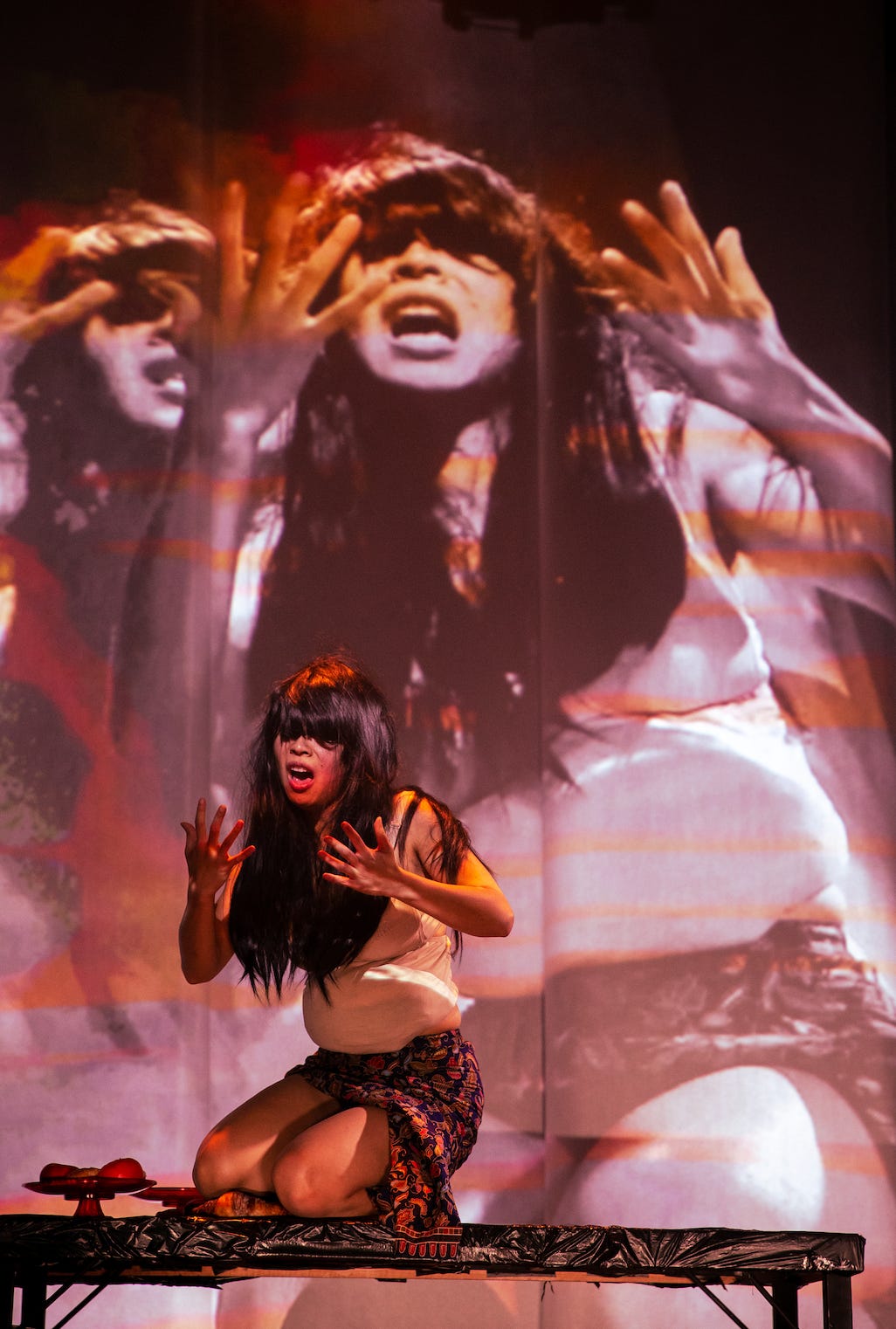
All my pieces have always been autobiographical, in the sense that I have always drawn it from my lived experience. At the same time, I can barely get over the bashfulness of telling the actual tedious details of the events of my life—in fact, I’m so elusive about my past and my family that friends past have joked that I’m an alien. Also, I can’t stand performing as myself, I can’t bear to do it more than a couple of minutes before I’m overcome by the itch of self-consciousness. I always need the monstrous leathery costume of a character to stand on stage:
So, this post is the first one, perhaps of a series, where I get to give myself space to be in that in-between space and tell stories and reflect and most importantly, amuse you!
I know when my mother was 30, she had had 3 children. I’m only slightly embarassed to admit that I think of the pieces I have created as my children (cue groans and tiny violins). Dear reader, I welcome you to laugh at me and call me pathetic. It is a bit laughable and a bit pathetic. But the truth is, after the actual livelihood and crucial wellbeing of some very dear people, there’s nothing more important to me than breathing a life into these pieces of theatre so they can walk and meet the world. In January 2023, during a particular dark night of the soul, I contemplated how I would feel if I only had a few months or years to live. The fact is, I would want to be exactly where I was, shaping and animating what became Prayers for a Hungry Ghost.
I’m curious how pieces begin for other people. For me, the seed is always a strange thing, sometimes it’s just a shred of an image, or a character, or text that don’t make sense. Three Sisters: Subtle, Vague & Ambiguous began, well, with the words ‘three sisters: subtle, vague & ambiguous’ and an image of a girl running away from people who wanted to kill her. Months before I put on the wig and the dress, Unforgettable Girl was a strange aura and a sharp perfumey scent that often came to me at sunset in my first few weeks in London. Prayers for a Hungry Ghost began as prayers, poems that I used to utter during lone panic attacks in the summer of 2021.
I think we all give canned answers to the question of ‘how did the idea for this piece come to you?’ in talkbacks and interviews. I’m guilty of this too. Surely, we can all commiserate in the fact that we live in a world of anxious ticked boxes. I think this question is also important because I know and have met countless brilliant artists who want to make their own work, but face systemic and personal barriers. But if we can tell each other what a path looks like in the dark, maybe we’d all find the light at the end of the tunnel a bit sooner!
 kisswitness.art
Leave a comment